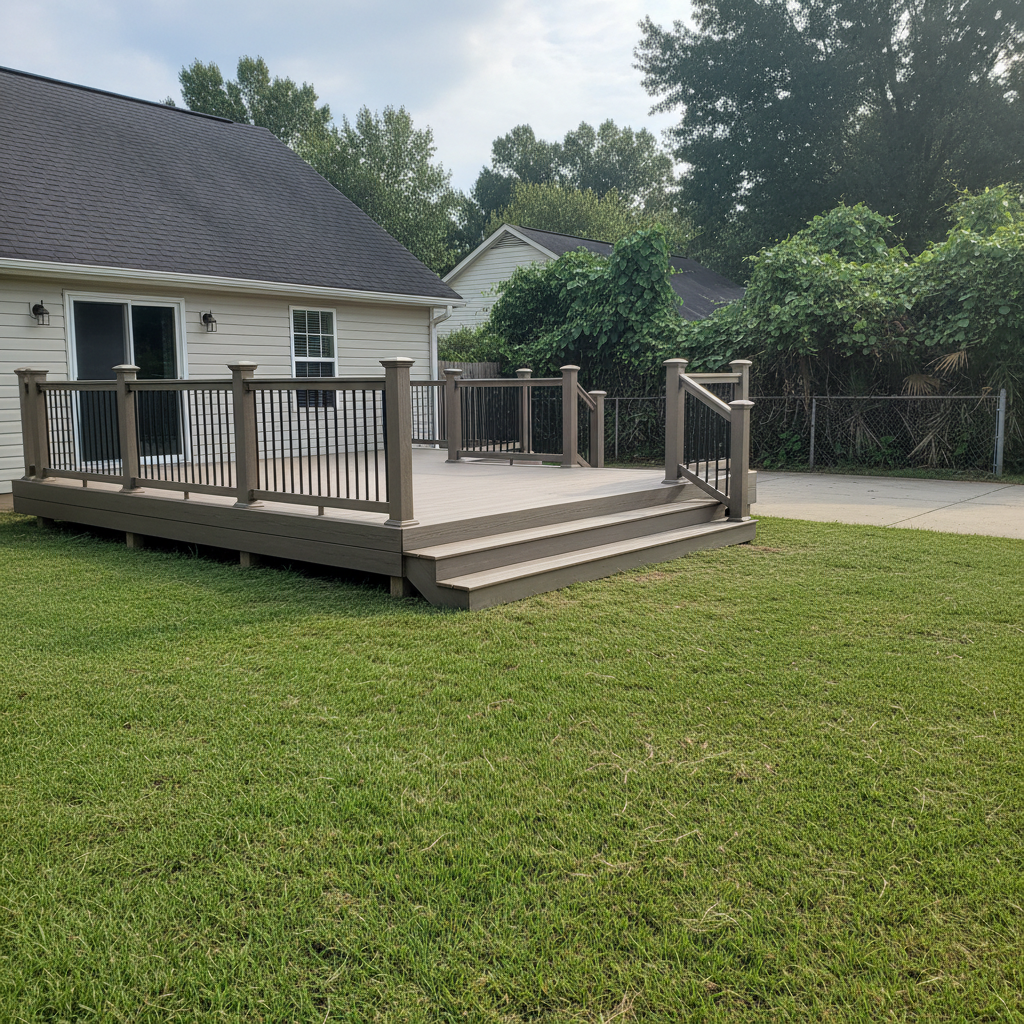
Most people shopping for a deck builder compare pictures. That tells you almost nothing about whether the deck will still be solid in eight years. What matters is underground, in the fasteners, and in the paperwork, and none of that shows up in a photo of finished boards.
What's holding the deck up matters more than what's on top of it
A deck is only as good as its footings. Around Southaven and the rest of DeSoto County, the soil is mostly clay with some loess mixed in closer to the river bluffs. Clay swells when it's wet and shrinks hard when it dries out, and a dry August after a wet spring will move a footing that wasn't poured deep enough. A builder working here should be setting posts on concrete footings below the frost line, which in north Mississippi runs around 12 inches, and most reputable builders go deeper than code minimum just because the clay moves. If someone tells you they're setting posts on precast concrete pads sitting on the surface, or just tamping gravel and calling it good, that's a deck that will rack and the railing will start to feel loose within a few seasons.
Ask how the deck ties into the house. The ledger board, the piece bolted to your rim joist, is where most deck failures actually start, not at the footings. It needs lag bolts or through-bolts, not nails, and it needs flashing that tucks up under the house wrap so water can't get behind it and rot the band joist. A builder who can't explain how they're flashing the ledger hasn't thought about it, which means they're probably not doing it.
Permits aren't a formality, they're a second set of eyes
Southaven and the surrounding towns require a building permit for most deck construction, especially anything attached to the house or built more than 30 inches off the ground. That triggers at least one inspection, usually a footing inspection before the concrete gets poured and a framing inspection before the boards go down. A contractor who tells you permits are a waste of time and money is telling you they don't want a county inspector looking at their footings. That should bother you more than the price. If your lot is in one of the newer subdivisions off Hwy 51 or out toward Olive Branch, there's also a decent chance you've got an HOA with its own rules on deck height, railing style, or even stain color, and that review can add a couple weeks before anyone breaks ground. Older streets closer to the original Southaven core generally don't have that layer, but they're more likely to have an existing deck from the 90s built to looser standards that needs to come out first.
Materials: ask what grade, not just what kind
"Pressure-treated" isn't one thing. There's a difference between lumber rated for ground contact and lumber that isn't, and a deck builder should know which parts of the frame need which. Joist hangers and structural screws should be hot-dip galvanized or stainless, not the cheap electro-galvanized hardware that corrodes within a few years against treated lumber's chemical makeup. That corrosion is invisible until a joist hanger lets go.
If you're looking at composite decking, ask about gap spacing. Composite expands and contracts with heat more than wood does, and Southaven summers push surface temperatures on a dark-colored composite board well past 140 degrees in July. A board installed tight in April without the right gap will buckle by August. Wood decking has the opposite problem here, humidity swings between a wet spring and a dry late summer mean the boards need room to move both directions, and a builder who doesn't account for that will leave you with cupped or split boards in a couple of years.
What a lowball bid usually means
If three bids come back close and one is 40 percent under the others, that difference is coming from somewhere. It's usually footing depth, hardware grade, or lumber spans that don't match the joist spacing they're actually using. A 2x8 joist at 16 inches on center can span further than most people think, but push that spacing to 24 inches to save material and the deck will feel bouncy under foot traffic almost immediately. Ask for the span table they're working from. A builder who's done this for years will have it memorized or will pull it up without hesitation.
Walk away from anyone who wants the full amount up front, won't put the scope of work in writing, or can't show you proof of liability insurance. A deck is heavy, it's elevated, and if a worker gets hurt on your property without coverage, that liability doesn't disappear just because you hired a handshake deal.
A few questions worth asking before you sign anything
- How deep are the footings going, and is that based on the soil here or a generic spec?
- Who pulls the permit, and is that cost included in the bid?
- What's the fastener schedule for the ledger board attachment?
- How long before I can walk on it, and how long before it can be stained or sealed if it's wood?
- What happens if the framing inspection doesn't pass the first time?
That last one matters. Framing inspections fail more often than people expect, usually over joist hanger nailing patterns or missing hurricane ties. A builder who treats a failed inspection as a normal part of the process, not a crisis, is probably someone who's dealt with it before and knows how to fix it fast.
None of this is complicated once you know what to ask. Most of it just isn't visible in a finished deck photo, which is exactly why so many homeowners find out the hard way. If you're weighing bids right now and want someone to walk the lot with you before you decide anything, that's the kind of conversation Ironwood Deck Co is happy to have, no pressure either way.